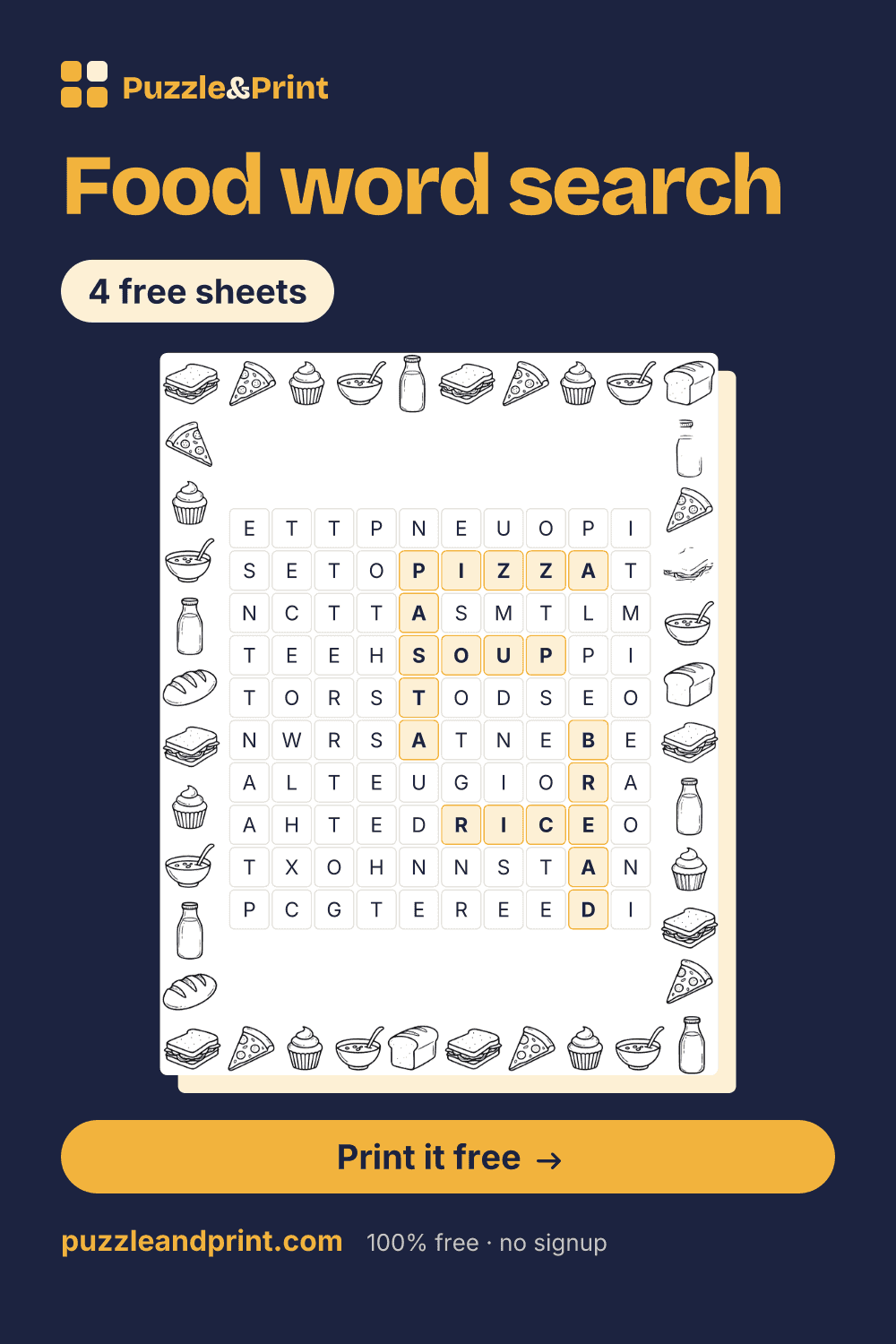
Food Word Search
- SANDWICH
- COOKIE
- DUMPLING
- PANCAKE
- CEREAL
- CURRY
- HONEY
- RICE
- CUSTARD
- PUDDING
- SCONE
- RISOTTO
Created for free at puzzleandprint.com
Food Word Search
Created for free at puzzleandprint.com
Food Word Search, Answer Key
Created for free at puzzleandprint.com
Four sheets, each with a different job. Every one is a two-page PDF, the puzzle, then the answer key on its own page.
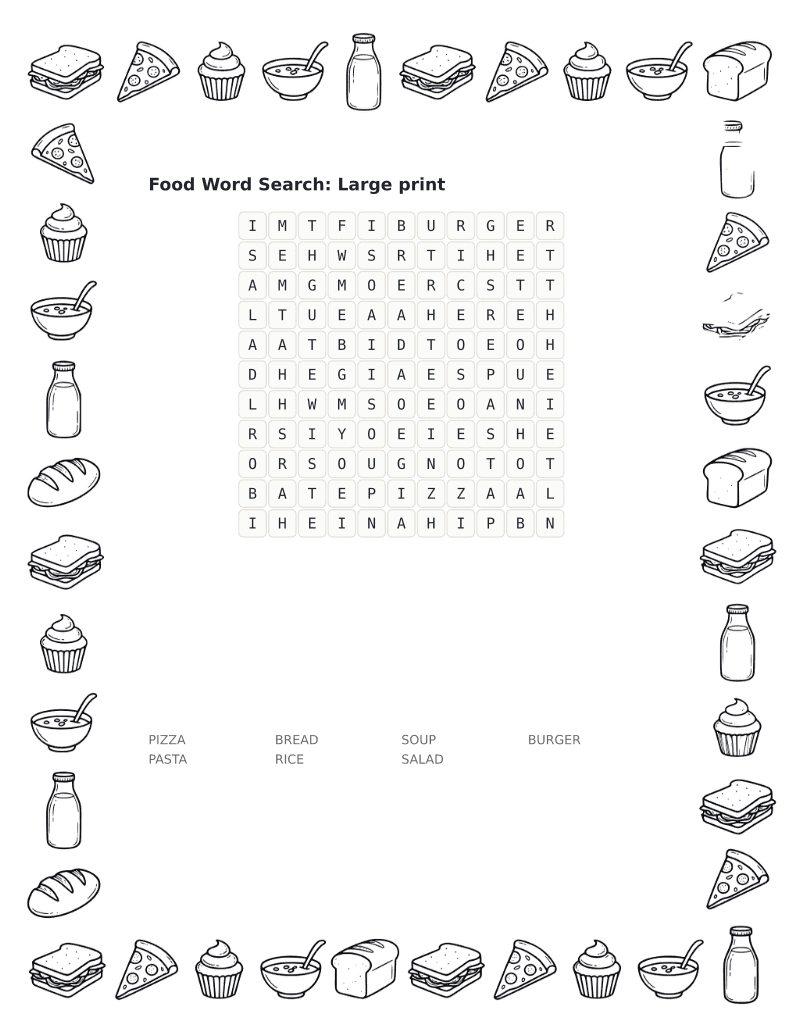 Food word search, large print11 × 11 · 7 words · EasyDownload PDF ↓
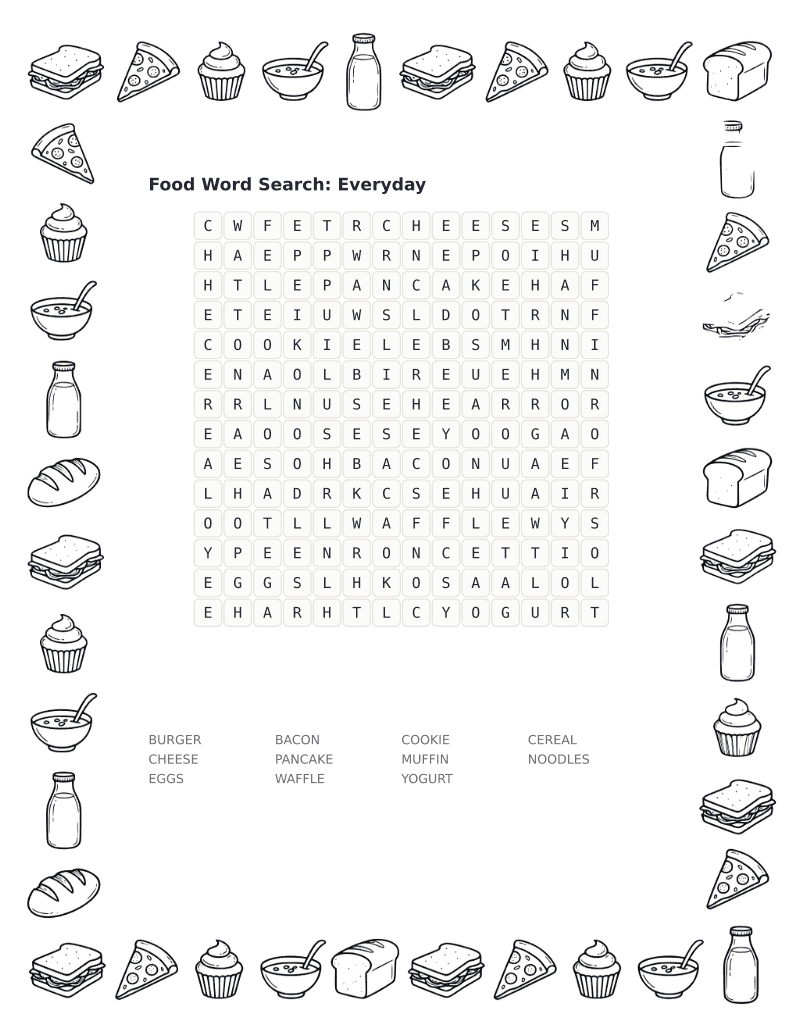 Food word search, everyday14 × 14 · 11 words · MediumDownload PDF ↓
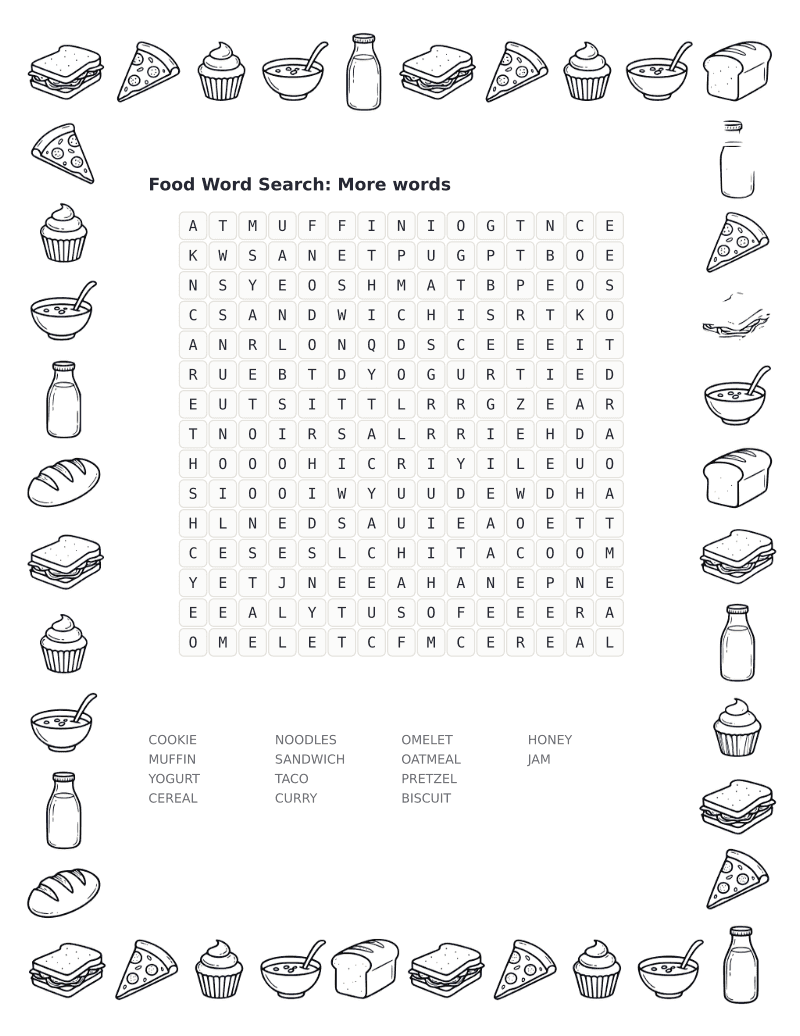 Food word search, more words15 × 15 · 14 words · MediumDownload PDF ↓
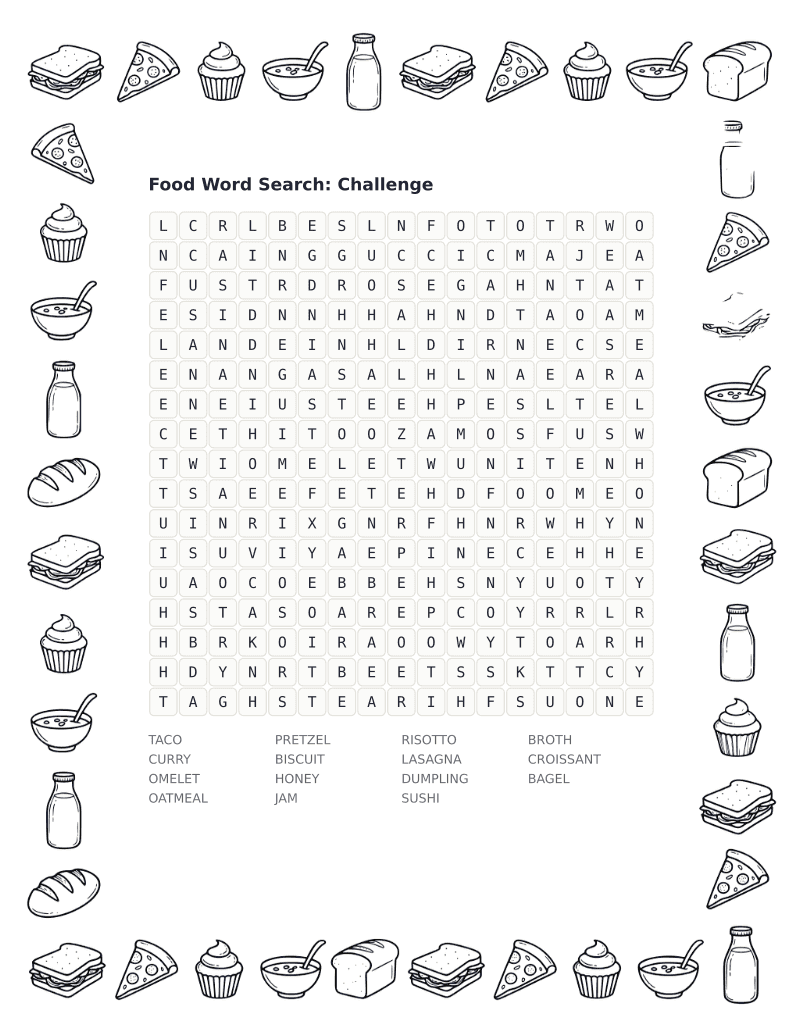 Food word search, challenge17 × 17 · 15 words · HardDownload PDF ↓
Every sheet here is free to print as often as you like. If one saved you time, the tip jar is on Ko-fi.
Food words are high-frequency and immediately meaningful, which makes this one of the easier themes to finish and the right choice for a child who needs a win: after a harder sheet has gone badly, or as the first puzzle of a session to get someone started.
It works particularly well for English language learners. The vocabulary is used every day, so a word earned here gets practiced at every meal without anyone arranging it.
The list runs from PIZZA and RICE up to CROISSANT and QUICHE, a wider spread of reading ages than the theme suggests. Seven of the forty, SCONE, CUSTARD, PUDDING, GRAVY, STEW, CHOWDER and QUICHE, appear on none of the four ready-made sheets, which work through the other thirty-three in list order.
Most of these forty are words children already say, which is the point, but a handful deserve a second look before anyone starts. CROISSANT, QUICHE and RISOTTO are borrowed spellings that follow French and Italian rules rather than English ones. A child who sounds them out will not find them; they have to be recognized whole. SANDWICH hides a D that nobody pronounces. BROTH and CHOWDER are the two most children will not have met in print, even if they have eaten both.
YOGURT and OMELET are often spelled differently on either side of the Atlantic, and this list uses one spelling of each, so check the sheet against the spelling your class is taught; BISCUIT is spelled the same everywhere but names a different food in Britain and America. Two pairs are useful for talking about sounds: PANCAKE and WAFFLE are both breakfast, both on the everyday sheet, and spelled nothing alike, and CHEESE and CHOWDER share a CH that QUICHE, the last word on the list, pronounces completely differently. That is a small honest lesson in why English spelling is learned rather than worked out.
Because the words are familiar, this theme suits going a size larger than usual, with one catch: each sheet takes a different stretch of the list, so moving up a size also means moving to later words. The large-print sheet’s seven words, PIZZA to BURGER, run only left to right or top to bottom in an eleven-square grid. The everyday sheet keeps BURGER, adds the ten from CHEESE to NOODLES and lets words run diagonally. More words repeats five of those, COOKIE, MUFFIN, YOGURT, CEREAL and NOODLES, then runs on from SANDWICH to JAM, and the challenge sheet repeats TACO to JAM, is the only one where words also run backwards, and finishes with CROISSANT and BAGEL.
All four print as two pages, the puzzle and then the answer key on its own sheet. For a party, the everyday and challenge sheets make a good pair because they share no words at all: neighbors on different sheets cannot pass answers across, and between them the two cover twenty-six of the forty food words.
Not the later ones, and that is intended. PIZZA, PASTA, BREAD, RICE, SOUP, SALAD and BURGER open the list and make up the whole large-print sheet, while RISOTTO, LASAGNA, DUMPLING and CROISSANT arrive on the challenge sheet, where a word nobody recognizes is part of the point.
Better than most themes, because everyone at the table has an opinion about the words. It also survives being done in short bursts between other things, which a puzzle at a party generally has to.
It is one of the better themes for it, because the words are ones a learner can point at on a plate. Start with the large-print sheet, whose seven words, such as BREAD, RICE and SOUP, are all four to six letters long. CROISSANT and RISOTTO, nine and seven letters, wait on the challenge sheet, where a learner who already knows the short words has something to stretch for.
New printables when they go up, mostly seasonal, a few times a year.