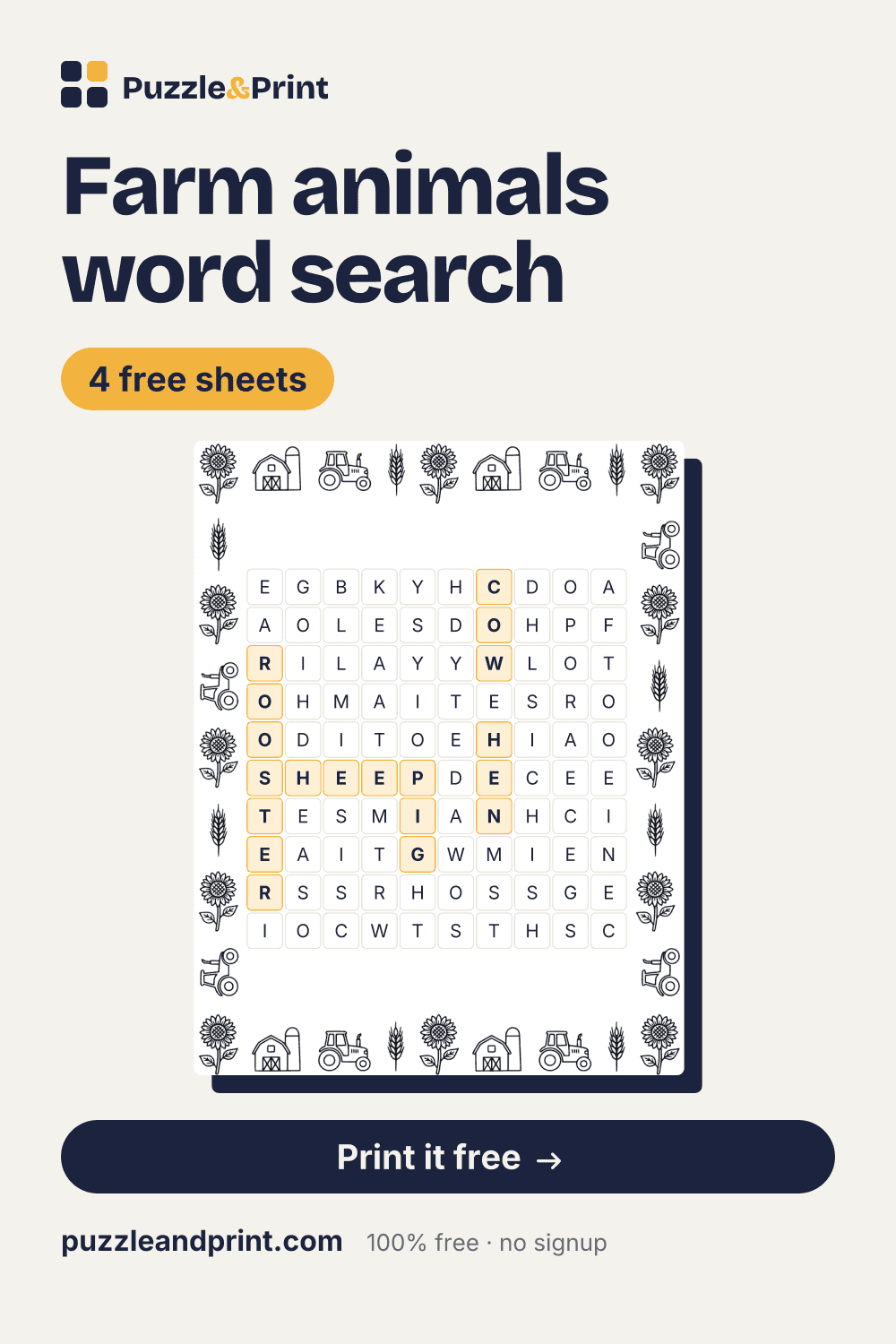
Farm animals Word Search
- HORSE
- ROOSTER
- OXEN
- LAMB
- KITTEN
- DONKEY
- HEN
- MARE
- DRAKE
- FOAL
- CALF
- PUPPY
Created for free at puzzleandprint.com
Farm animals Word Search
Created for free at puzzleandprint.com
Farm animals Word Search, Answer Key
Created for free at puzzleandprint.com
Four sheets, each with a different job. Every one is a two-page PDF, the puzzle, then the answer key on its own page.
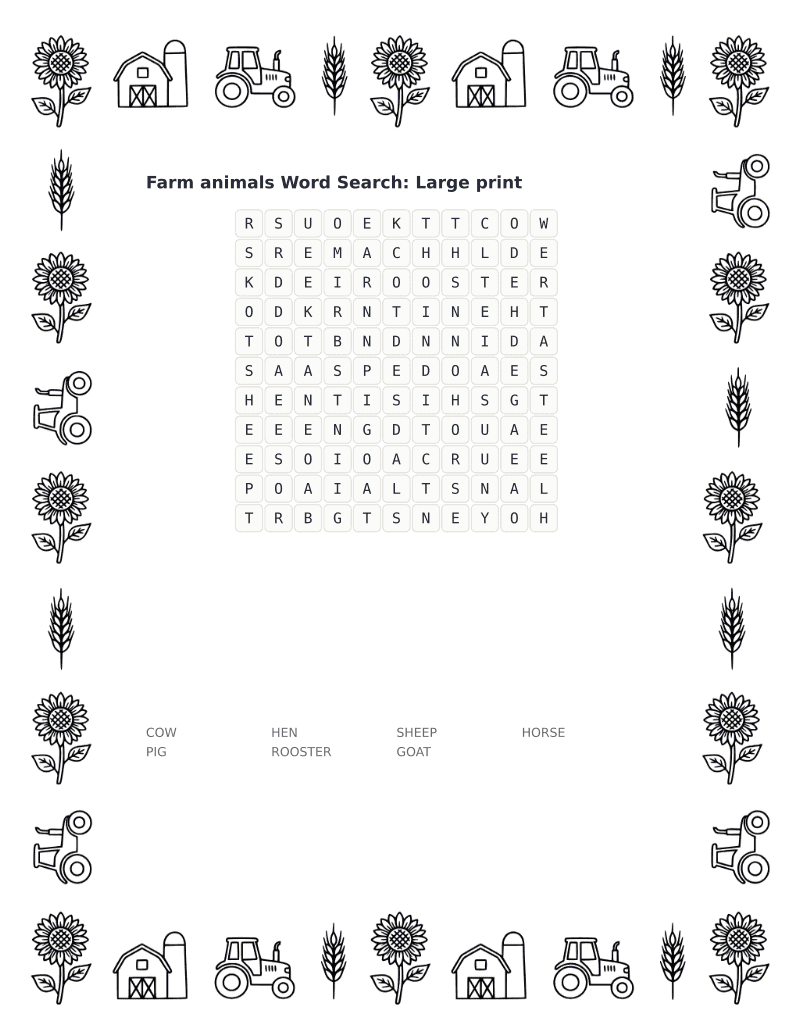 Farm animals word search, large print11 × 11 · 7 words · EasyDownload PDF ↓
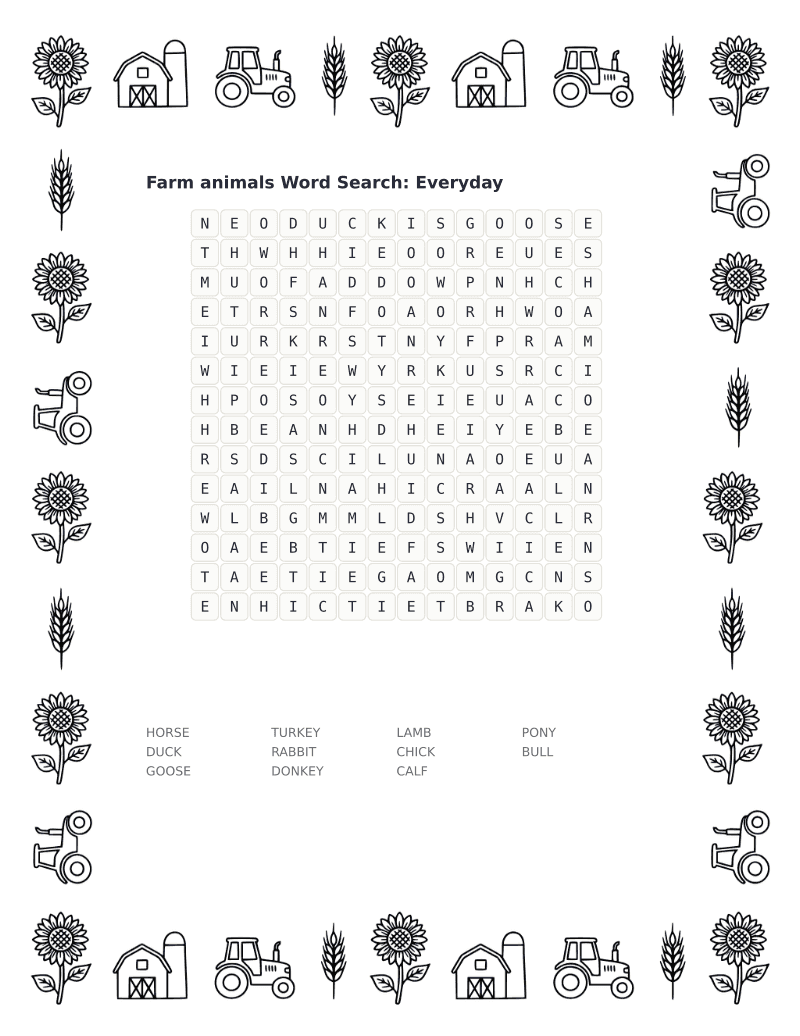 Farm animals word search, everyday14 × 14 · 11 words · MediumDownload PDF ↓
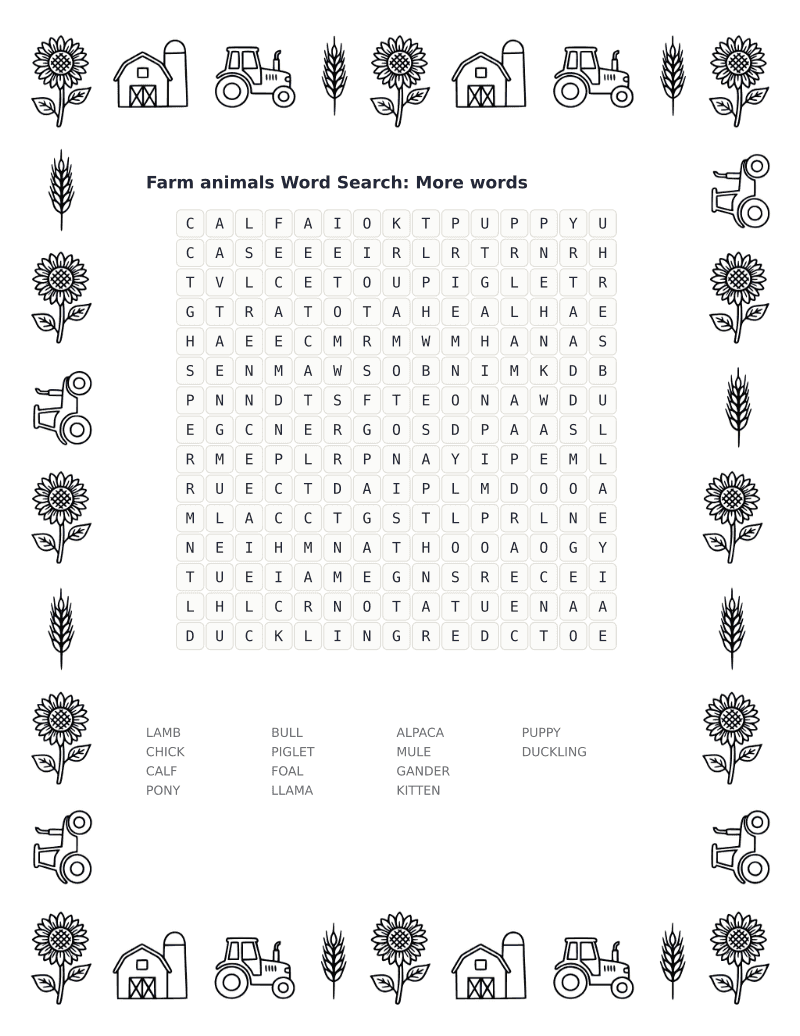 Farm animals word search, more words15 × 15 · 14 words · MediumDownload PDF ↓
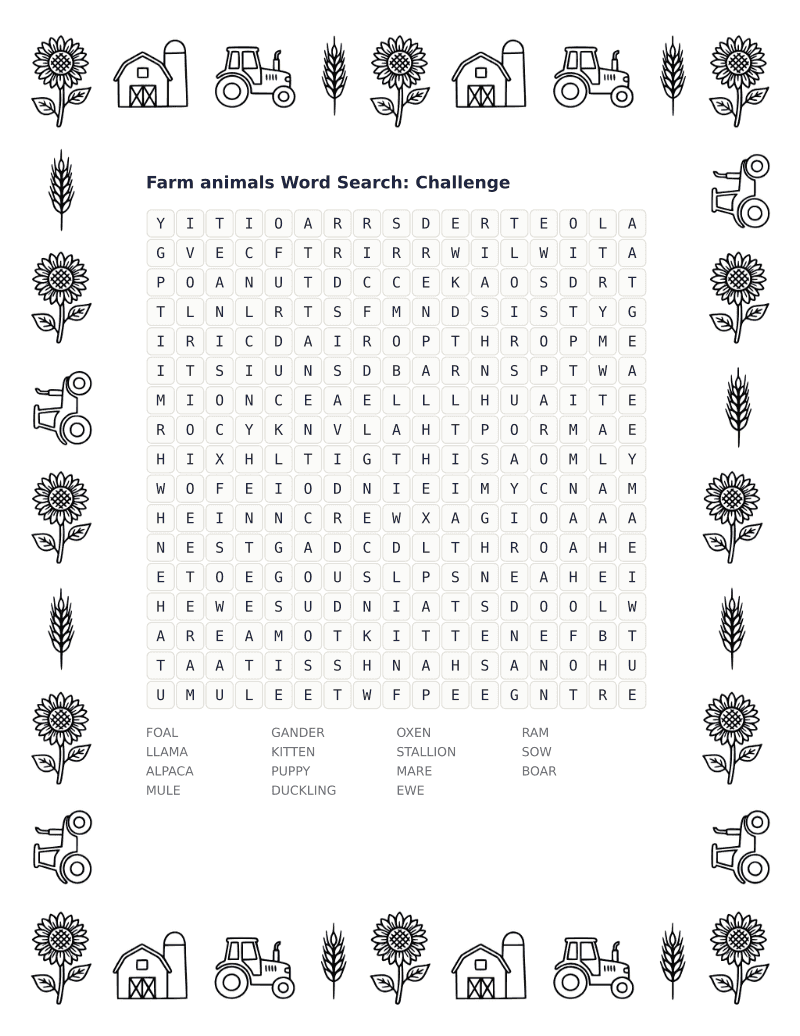 Farm animals word search, challenge17 × 17 · 15 words · HardDownload PDF ↓
Every sheet here is free to print as often as you like. If one saved you time, the tip jar is on Ko-fi.
Nine of the forty words on this list name a baby animal (LAMB, CHICK, CALF, PIGLET, FOAL, KITTEN, PUPPY, DUCKLING and GOSLING), which makes it useful for more than a word hunt. Asking which animal each baby belongs to turns a finished sheet into a second, better activity.
Most of the words are short: 27 of the 40 have five letters or fewer, and COW, PIG, HEN, EWE, RAM and SOW have only three. The longest, DUCKLING and STALLION, have eight, so every word fits the maker’s smallest grid, ten by ten, which with six words makes a sensible first word search.
Not every adult on the list has its young beside it, and the gaps make good questions. GOAT, TURKEY, RABBIT, LLAMA and ALPACA have no baby word here: a young goat is a kid, a young turkey a poult, a young rabbit a kit, and a young llama or alpaca a cria. A young DONKEY, like a young HORSE, is a FOAL.
Two baby names begin with their parent’s name: PIGLET starts with PIG and DUCKLING with DUCK. No ready-made sheet has both words of a pair, but type both into your own list in the maker and the short word can be found twice, once where it was placed and once inside the long one.
Eight pairs on the farm animals list name the male and the female of the same animal: BULL and COW, RAM and EWE, STALLION and MARE, BOAR and SOW, ROOSTER and HEN, GANDER and GOOSE, DRAKE and DUCK, and BILLY and NANNY for goats. DUCK and GOOSE do double duty, since each is also the everyday word for the whole species, and a child who notices that has spotted something about English that most adults never think about. Pairing male with female is a different exercise from matching young to parent, and a harder one, because few children know that a male duck or a male goose has a name of its own.
A few of the other words are worth a sentence each. OXEN is the plural of ox, and one of very few English plurals that end in en, alongside children. SHEEP makes a good contrast, since it stays the same whether there is one or a field of them. MULE is the offspring of a donkey and a horse, which is why it sits naturally beside DONKEY and HORSE, both on the everyday sheet. LLAMA and ALPACA both come from South America, and LLAMA is one of the few English words that start with a double letter. BANTAM is a small breed of chicken rather than a separate kind of bird.
The more words sheet is the farm sheet with the baby animals: LAMB, CHICK, CALF, PIGLET, FOAL, KITTEN, PUPPY and DUCKLING are eight of its fourteen words. PONY sits among them and is the word to stop on, because children often assume a pony is a young horse. A young horse is a FOAL; a pony is a kind of horse that stays small when fully grown. The sheet is fifteen squares across at the medium setting, so words can run down a diagonal as well as across and down, and DUCKLING, at eight letters, is its longest word. If the young-and-parent matching game is the plan, this is the sheet to print.
The challenge farm sheet turns to the adults and to the three-letter names: EWE, RAM and SOW sit among STALLION, MARE, BOAR and OXEN on a seventeen-square grid where words can run in all eight directions. EWE is a palindrome, so it reads correctly either way. RAM is the trap: MARE read backwards ends in R, A, M, so on this sheet a RAM can be found inside MARE as well as where it was placed, and both should count. The large print sheet sits at the other extreme. Its seven words run only across and down, so nothing on it reads backwards at all, even though COW, PIG and HEN are just as short.
Match the young to the adult. Print the large print and more words sheets together and five young animals meet a parent across them: CALF and COW, PIGLET and PIG, CHICK and HEN or ROOSTER, LAMB and SHEEP, FOAL and HORSE. On the challenge sheet alone, FOAL pairs with MARE and STALLION, while DUCKLING, KITTEN and PUPPY leave a child to name the parent.
They are unfamiliar to most children, which is why none of the four ready-made sheets uses them, and GOSLING, DRAKE, STEER and BANTAM are left off too. They stay on the list for the maker on this page, which picks from all forty words, while the large print sheet keeps to COW, PIG, HEN, ROOSTER, SHEEP, GOAT and HORSE.
Because cats and dogs are part of life on many farms, cats for keeping down mice and dogs for working with sheep and cattle, so KITTEN and PUPPY sit on the list beside the livestock. Both are on the more words and challenge sheets, where they give a child from a town two familiar words among less familiar ones.
New printables when they go up, mostly seasonal, a few times a year.