Dinosaurs Word Search
- VOLCANO
- CLAWS
- CARNIVORE
- AMBER
- FERNS
- BONES
- DIPLODOCUS
- JURASSIC
- TUSKS
- TEETH
- ALLOSAURUS
- STEGOSAURUS
Created for free at puzzleandprint.com
Dinosaur names and the words that go with them.
Last updated
Save this to PinterestDinosaurs Word Search
Created for free at puzzleandprint.com
Dinosaurs Word Search, Answer Key
Created for free at puzzleandprint.com
Four sheets, each with a different job. Every one is a two-page PDF, the puzzle, then the answer key on its own page.
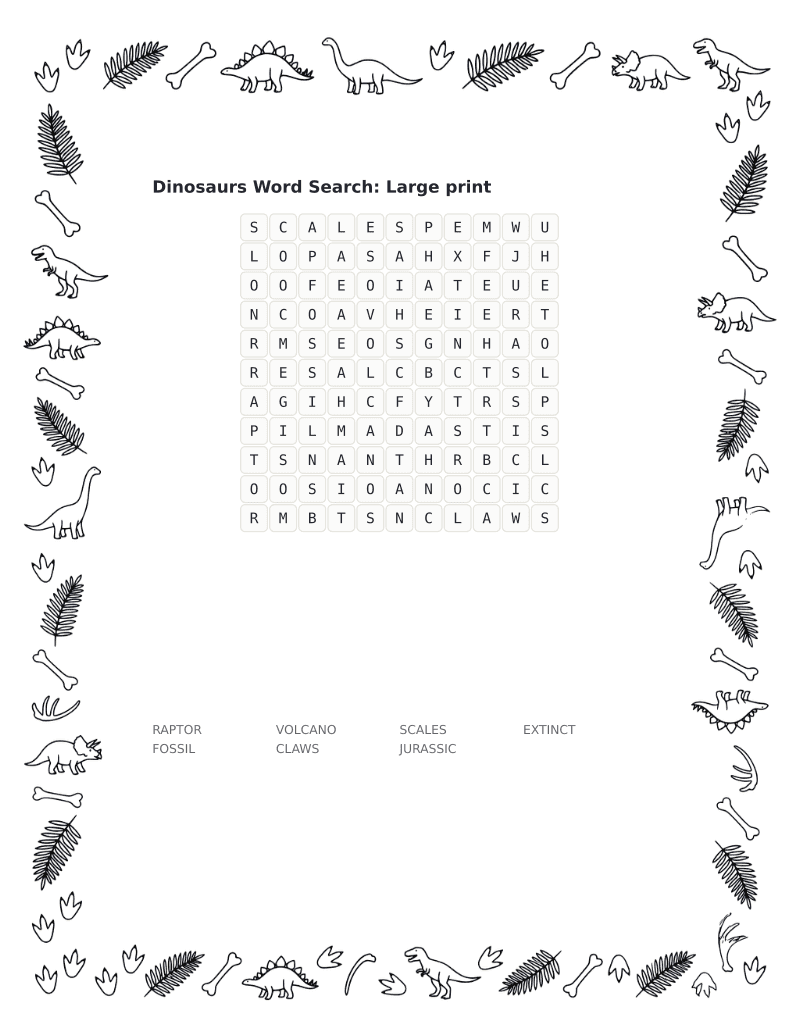 Dinosaurs word search, large print11 × 11 · 7 words · EasyDownload PDF ↓
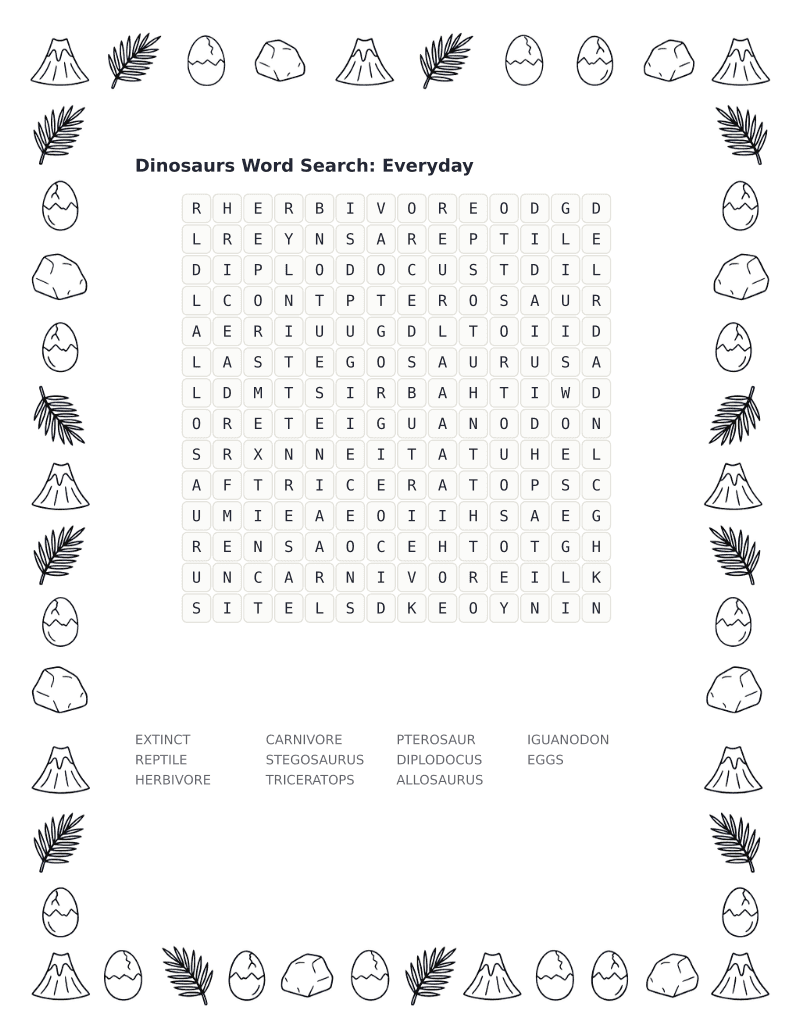 Dinosaurs word search, everyday14 × 14 · 11 words · MediumDownload PDF ↓
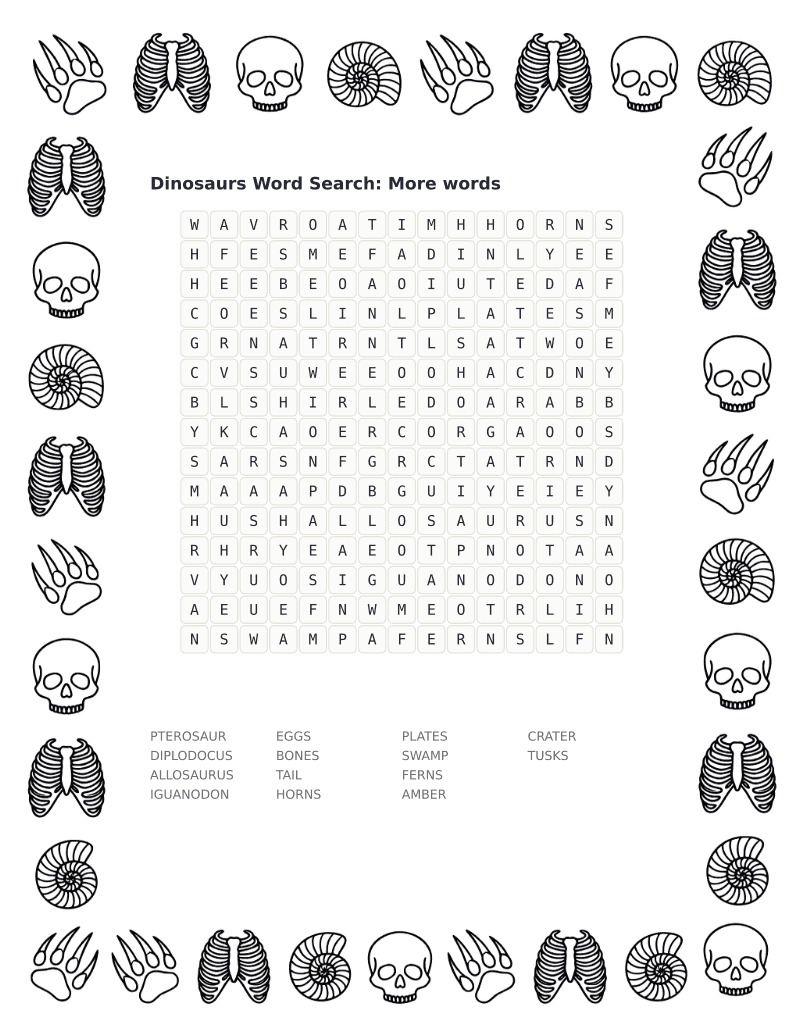 Dinosaurs word search, more words15 × 15 · 14 words · MediumDownload PDF ↓
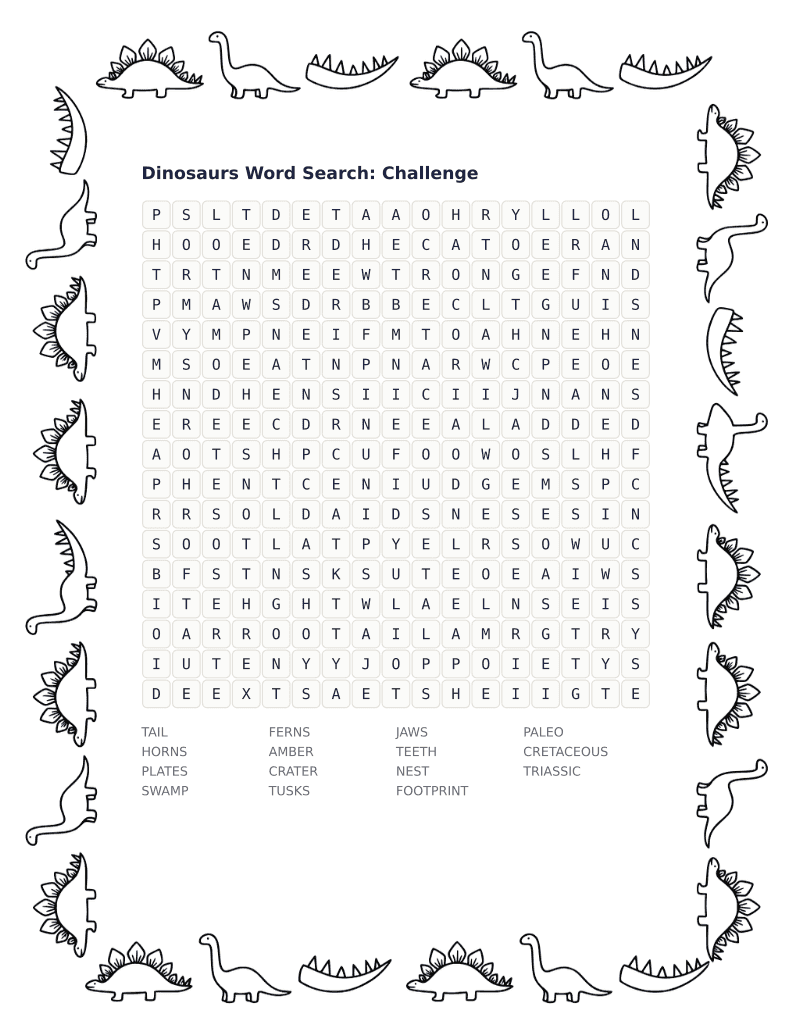 Dinosaurs word search, challenge17 × 17 · 15 words · HardDownload PDF ↓
Every sheet here is free to print as often as you like. If one saved you time, the tip jar is on Ko-fi.
Dinosaur names are long, strange and phonetically demanding, which is exactly why children who resist reading practice will happily do this. Stegosaurus is eleven letters of decoding dressed up as fun.
The two longest words on the list, STEGOSAURUS and TRICERATOPS, are eleven letters each, and the maker on this page opens with both of them among twelve words in a fourteen-square grid, so a bigger grid is not needed to fit them. The list also mixes in the surrounding vocabulary (fossil, herbivore, extinct), so a sheet doubles as a topic glossary.
Worked in order, the four sheets overlap: the more-words sheet repeats five words from the everyday sheet, including DIPLODOCUS and IGUANODON, and the challenge sheet repeats eight from the more-words sheet, from TAIL to TUSKS. A child who meets IGUANODON a second time in a bigger grid already knows how it is spelled, so the second search becomes a spelling check rather than a first encounter.
The large-print sheet works without the long Greek names: RAPTOR, CLAWS and SCALES describe the animal, FOSSIL and EXTINCT what became of it, and VOLCANO and JURASSIC the world it lived in, all inside an eleven-square grid where words run only across and down.
STEGOSAURUS means roofed lizard and TRICERATOPS means three-horned face: most of the dinosaur names on the list are descriptions in Greek, and saurus, meaning lizard, is the piece that turns up most often. ALLOSAURUS means different lizard, DIPLODOCUS double beam, after a row of bones under its tail, and IGUANODON iguana tooth, because its teeth looked like a modern iguana’s. SAUROPOD and THEROPOD, two of the big groups, mean lizard foot and beast foot. Telling a child what a name means turns a long string of letters into a description they can check against a picture, which is how the long names stick.
The three periods of the dinosaur age are all on the list, and from oldest to youngest they run TRIASSIC, JURASSIC, CRETACEOUS. JURASSIC is on the large-print sheet, while TRIASSIC and CRETACEOUS are both on the challenge sheet, so a child on that sheet can find two of the three and be asked which one is missing. CRETACEOUS comes from the Latin for chalk, and at ten letters, with a soft C and an eous ending, it is one of the hardest words on the page to spell. PALEO is the American spelling; British books write palaeo, as in palaeontology.
The everyday dinosaur sheet has the longest names on the page because all five of the list’s full dinosaur names sit on it together: STEGOSAURUS, TRICERATOPS, DIPLODOCUS, ALLOSAURUS and IGUANODON, with PTEROSAUR, HERBIVORE and CARNIVORE alongside. Eight of its eleven words are nine letters or more, packed into a fourteen-square grid, so it can read as harder than the challenge sheet even though its words only run across, down and diagonally downwards. Give it to a confident reader rather than automatically to whoever usually gets the second sheet, or read the eleven words aloud together before anyone starts.
Four of the five are plant-eaters, STEGOSAURUS, TRICERATOPS, DIPLODOCUS and IGUANODON, and ALLOSAURUS is the one meat-eater, which makes HERBIVORE and CARNIVORE on the same sheet a ready-made sorting task. The challenge sheet takes the opposite approach and names no dinosaur at all: its fifteen words are mostly body parts and evidence, TAIL, HORNS, PLATES, JAWS, TEETH and FOOTPRINT beside AMBER, FERNS and SWAMP. Matching HORNS to TRICERATOPS and PLATES to STEGOSAURUS links the two sheets, and it works best when both are printed for the same child.
Not if a younger child starts on the large-print sheet, where the longest word is JURASSIC at eight letters. STEGOSAURUS and TRICERATOPS, eleven letters each, appear on the everyday sheet only; the more-words sheet keeps the ten-letter DIPLODOCUS and ALLOSAURUS but sets them among short words such as EGGS, BONES and TAIL.
MUSEUM and DIGSITE are on the full list of forty because museums and dig sites are where children actually meet dinosaurs, though neither is on any of the four ready-made sheets. Either can turn up when the maker on this page picks words from the whole list, as can SKELETON, TALON, PREDATOR, SAUROPOD and THEROPOD, the other five words no sheet uses; FOSSIL, PALEO and CRATER are the parts of that vocabulary the sheets do carry.
No: pterosaurs were flying reptiles that lived alongside the dinosaurs and were close relatives of them, but they are not counted as dinosaurs. PTEROSAUR is on the everyday and more-words sheets, and it is worth saying so when a child finds it, since the two so often appear together in books and toy sets.
New printables when they go up, mostly seasonal, a few times a year.