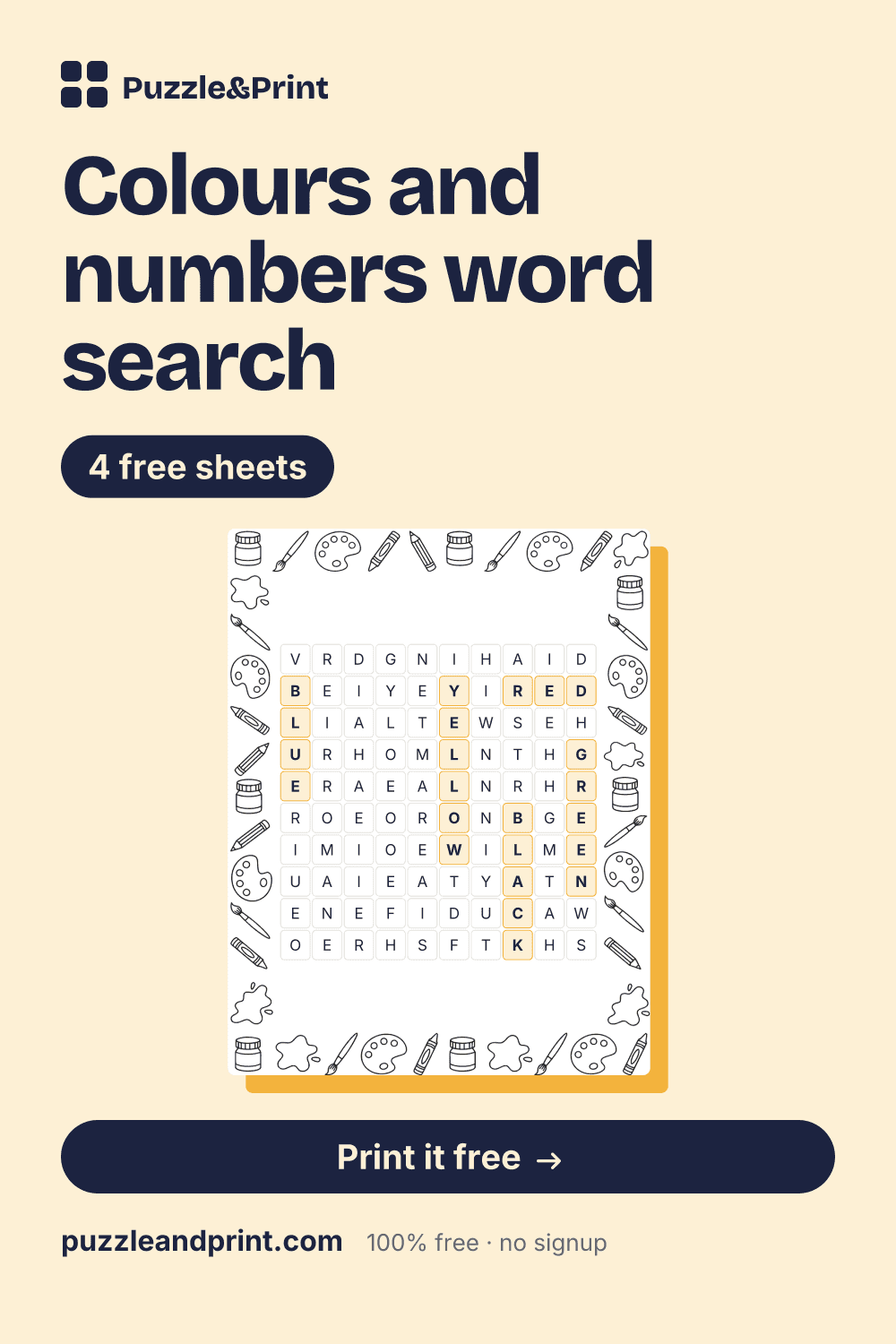
Colours and numbers Word Search
- VIOLET
- TWELVE
- BLUE
- THREE
- FOUR
- FOURTEEN
- MAROON
- YELLOW
- TEAL
- INDIGO
- FIFTEEN
- ZERO
Created for free at puzzleandprint.com
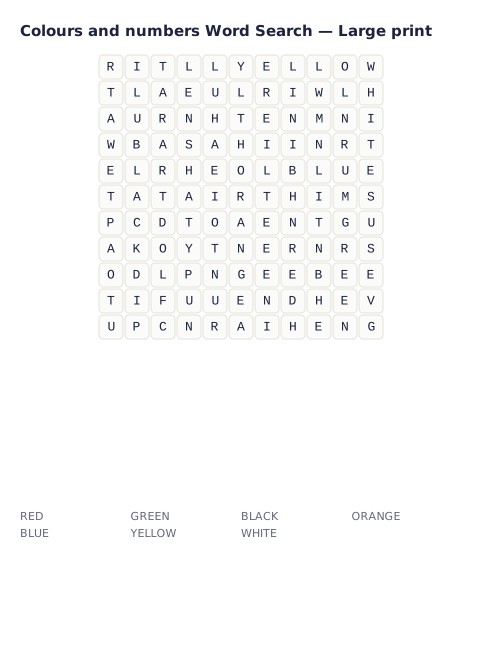
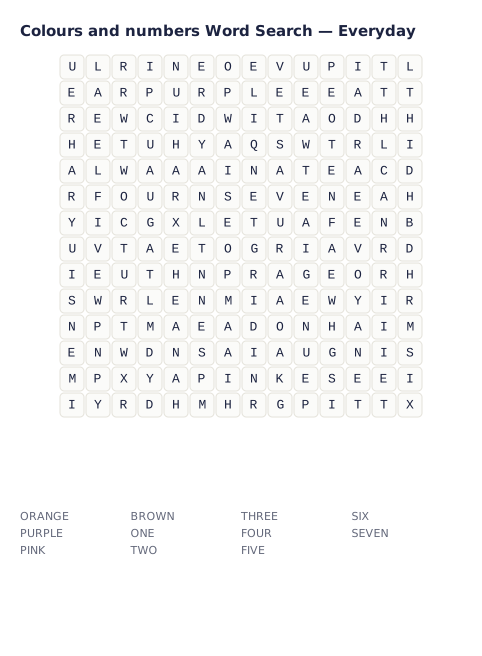
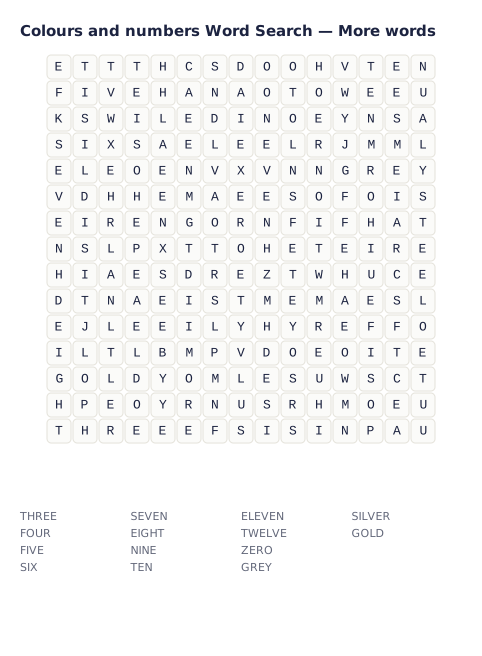
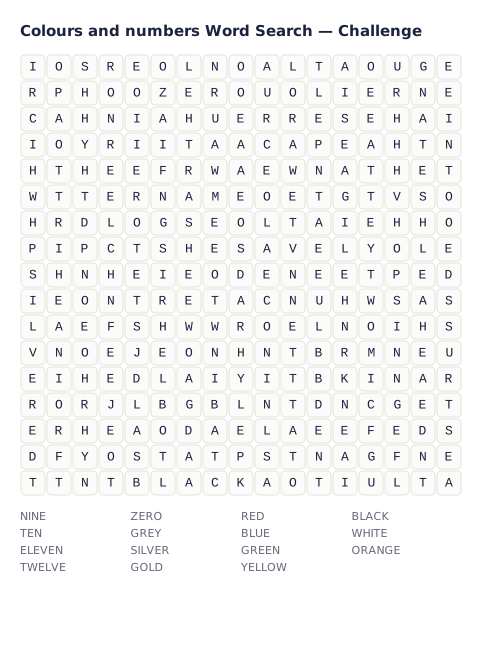
Colour words and the numbers from zero to twelve.
Save this to PinterestCreated for free at puzzleandprint.com
Created for free at puzzleandprint.com
Four sheets, each with a different job. Every one is a two-page PDF, the puzzle, then the answer key on its own page.
Colours and number words are among the very first vocabulary children are asked to read rather than count or point at, and they are deceptively hard: eight and twelve look nothing like they sound.
The words are short, which means a small grid with big letters works well. This is a reasonable first word search for a child who has just started reading whole words.
The number words are worth more attention than the colours. A child can usually count to twelve long before they can read the word twelve, and the gap between those two skills is exactly what this sheet exposes.
If it is going slowly, drop to a ten by ten grid with six or seven words. Finishing quickly and asking for another is a far better outcome than grinding through a full page.
Because a child can usually count to twelve long before they can read the word twelve. EIGHT and FOUR look nothing like they sound, so the puzzle exposes a gap that counting aloud hides completely.
Partly, and it is worth trying. A child who knows their letters can match RED or SIX shape by shape without reading either, which is real practice. Hold back ELEVEN, THIRTEEN and FOURTEEN until whole words are going in, or they will just be long strings.
Up to twenty-five. Ten to fifteen is comfortable for most grids. If you add more than the grid can hold, the tool tells you which words did not fit rather than silently leaving them out.
Either it is longer than the grid is wide, or the grid filled up before it could be placed. Try the next size up, remove a word, or press New puzzle for a different arrangement, a word that fails one layout often places fine in the next.
Yes. Set difficulty to Easy so words only run left to right and top to bottom, and use a 10 by 10 grid with five to eight short words. That combination is manageable for most children who can read the words on the list.
Always, and it prints on its own page so you can hand out the puzzle without it. Each answer is marked directly on a copy of the grid.
No. There is no sign-up, no email, and no watermark on the printed sheet. Puzzles are built in your browser, so your word list never reaches us.
Yes, use them with your class, your family, your club, or your care home, and print as many copies as you need. The one thing we ask is that you do not resell the sheets themselves.
New printables when they go up, mostly seasonal, a few times a year.